
How to evaluate a neighborhood beyond the listing
Updated September 24, 2026
Visit at three different times (a weekday rush hour, a weekend morning, and after dark), walk the block once with no destination, and run your real commute and errands. A neighborhood shows you its actual life in the details the listing leaves out: noise, light, traffic, and how people use the street.
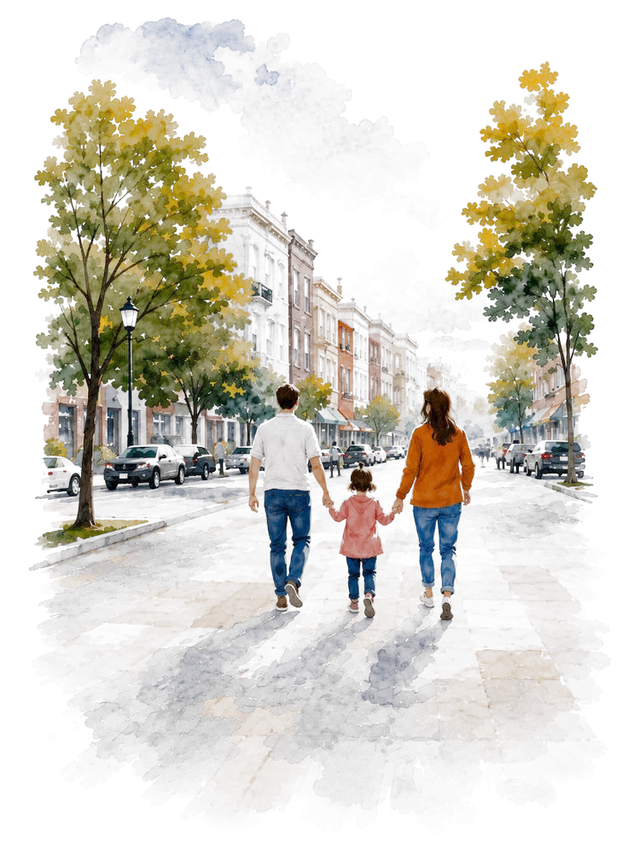
You can renovate a kitchen. You cannot renovate a street. The neighborhood is the one part of the purchase you take exactly as-is, and it’s also the part the listing works hardest to art-direct: golden-hour photos, “vibrant” this, “quiet tree-lined” that. Here’s how to find out for yourself.
The three-visit rule
A neighborhood is a different place at different hours, and the tour was scheduled for its best one. Before you offer, see it three times:
- Weekday rush, roughly 7:30 to 9 am. This is the neighborhood on assignment: the commute crawl, the school drop-off queue, whether that “quiet side street” is actually the cut-through the map apps found. Sit in what would be your driveway spot and just watch for ten minutes.
- Weekend late morning. The social read. Kids out? Garage projects? Dog walkers who greet each other? Empty and silent? None of these is wrong; the question is whether it matches the life you’re picturing.
- After dark, past 9 pm. Walk a block. Notice the lighting, the noise floor, the cars, how you feel. Night is when a street tells you whether you’ll relax here.
If the house is near anything with hours (a school, a venue, a restaurant strip, a church), add one visit while that thing is running.
The walk test
Park two blocks away, ideally at the nearest corner you’d walk to for anything, and walk to the house with no agenda. Sidewalks: continuous, buckled, missing? Yards: kept, fenced, bare? Do you pass anyone, and does anyone nod? What does the block sound like halfway down?
Then keep going past the house and do the errand loop on foot or by car: coffee, groceries, pharmacy, park. Clock the minutes. “Walkable” in a listing can mean a lovely eight-minute stroll or a shoulderless sprint across a five-lane road. Your legs will give you the honest number.
The noise inventory
Noise is the top thing buyers say they missed, because tours are quiet by design and adrenaline is loud. Do a deliberate listen:
- Stand in the backyard for sixty seconds without talking. Count the layers: traffic wash, HVAC units, the highway you can’t see, planes on approach.
- Open a bedroom window on the tour. Double-pane glass flatters every street.
- Check the map for the loud infrastructure the photos crop out: rail lines, fire stations, hospitals (sirens), stadiums, and bar districts within a half mile.
- Come back once on a warm evening. Sound carries differently, and warm nights are when the neighborhood is outside.
The commute dry run
Don’t trust the map estimate; drive it. Once at your real leaving time on a weekday morning, and back at your real evening time. Note the pinch points, not just the total: some 25-minute commutes feel fine, and some 25-minute commutes have one left turn that will shave years off your life. If you’ll use transit or bike, do that version too, including the walk on each end.
The public-record reads
Some things you check with data, not impressions, and primary sources beat one-number scores:
- Schools. District boundary maps first (confirm the address actually feeds the school you think it does; boundaries surprise people). Then the state’s school report card if you want depth.
- Safety. Many police departments publish incident maps. Look at patterns over months, not single dots, and calibrate with your own night walk.
- What’s coming. The county’s planning or zoning page tells you about the empty lot two doors down before it becomes a drive-through. Ten minutes of searching the parcel can save a decade of regret.
- Flood and water. FEMA’s flood maps are public and free, and “we didn’t check” is an expensive sentence.
Talk to one human
If you see a neighbor outside, take the shot: “Hi, we’re looking at the blue house. How do you like the street?” People are generous about where they live, and they will tell you the things no dataset holds: the drainage in heavy rain, whether the block party still happens, which neighbor plows everyone’s sidewalk, the dog. One conversation is worth twenty tabs.
Keep what you noticed
Every one of these visits produces perishable data: the smell of the bakery on the corner, the exact sound of the street at 9:40 pm, how the light hit the porch on your night walk. Capture it while you’re standing in it (photos, a voice note, one line about how the street felt), and keep it attached to the homes you’re considering there. When you’re down to two finalists in two different neighborhoods, what you noticed on the ground is exactly the evidence the decision needs.
Quick answers
- What time of day should you visit a neighborhood before buying?
- Three times minimum: a weekday between about 7:30 and 9 am for the traffic and school-run truth, a weekend morning for how the street actually gets used, and once after 9 pm for noise, lighting, and how it feels to walk. One sunny Saturday tour is the neighborhood's audition, not its everyday.
- How do I check if a neighborhood is quiet?
- Stand still on the sidewalk for a full minute, twice: once during the day, once at night. Listen for the layers under the obvious: highway wash, flight paths, train horns, a bar patio two streets over. Open the bedroom window on the tour too; glass hides a lot.
- How do I research schools and safety without relying on rumors?
- Go to primary sources and walk them yourself. School district sites publish boundary maps and report cards; local police departments often publish incident maps. Treat one-number ratings as a starting question, not an answer, and weigh what you observe on the ground at least as heavily.
- Should I talk to the neighbors before buying a house?
- Yes, if you get the chance. One porch conversation ('we're thinking about the blue house, what's the street like?') yields more truth than an hour online. Neighbors will tell you about the drainage, the block party, and the dog that barks all night, usually unprompted.